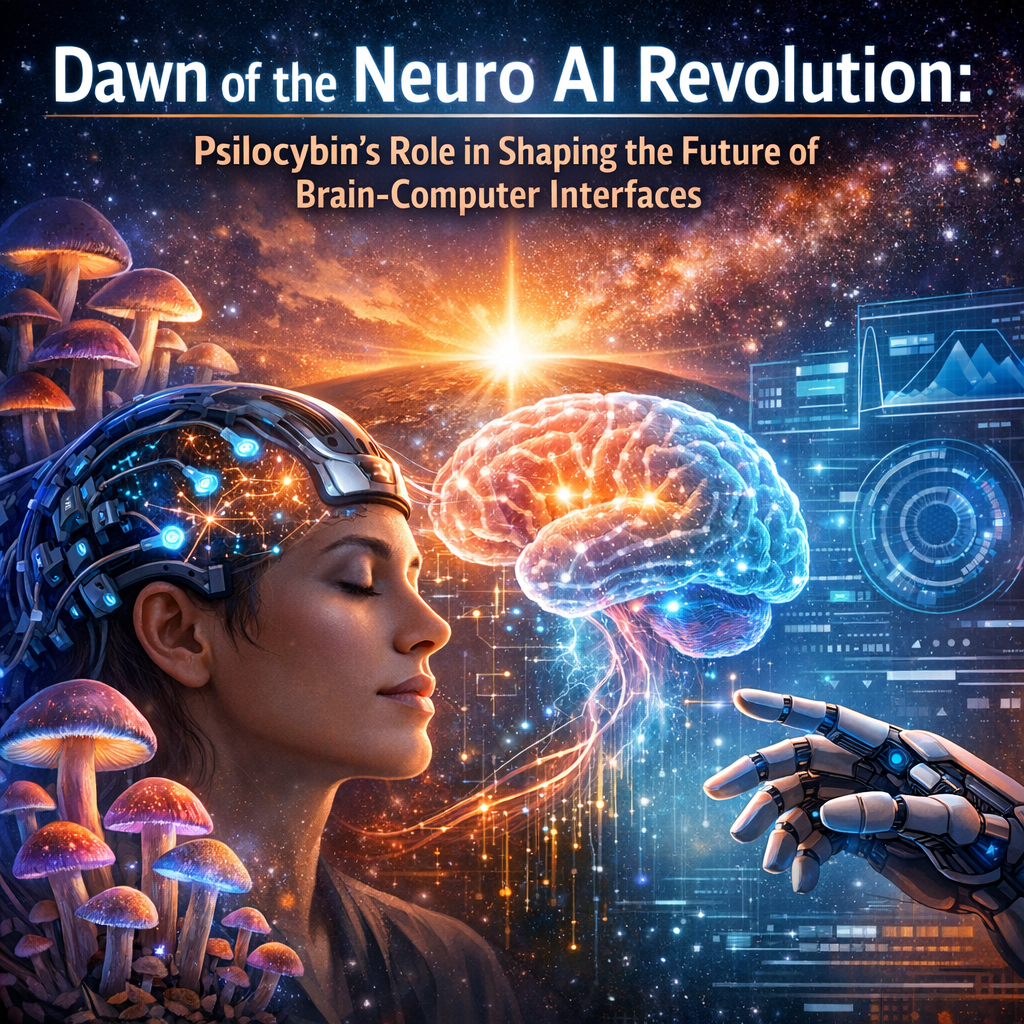
Dawn of the Neuro AI Revolution: Psilocybin’s Role in Shaping the Future of Brain-Computer Interfaces
Introduction
The field of **neuroscience** is undergoing a remarkable evolution, driven by advancements in **artificial intelligence (AI)** and the growing interest in the potential of **psychedelics** like **psilocybin**. As we stand on the precipice of a technological revolution, **brain-computer interfaces (BCIs)** are emerging as a groundbreaking convergence of technology and biology, promising to transform the way we interact with machines.
Psilocybin, the **psychoactive compound** found in certain mushrooms, has traditionally been recognized for its **therapeutic properties**, particularly in **mental health**. However, recent research highlights its potential in enhancing **cognitive functioning** and **neuroplasticity**, making it a promising candidate in the development of BCIs. These interfaces, which facilitate direct communication between the brain and external devices, have vast implications—from aiding those with **neurological disorders** to pushing the boundaries of **human cognition**.
As the world becomes increasingly digital, the integration of BCIs into everyday life is becoming more conceivable. With the aid of AI, these interfaces can be more intuitive, learning and adapting to unique **neural patterns**. Psilocybin’s ability to induce a state of heightened **neural connectivity** and facilitate profound psychological insights could potentially enhance the effectiveness of BCIs, making interactions more seamless and deeply integrated.
As we advance into this new era, understanding the synergistic potential of psilocybin and AI-driven BCIs could unlock unprecedented possibilities. The exploration of psilocybin as a cognitive enhancer within this field is not just about augmenting brain functionality but transforming the interface to foster a more holistic relationship between humans and technology. This exploration could redefine how individuals experience **consciousness** and interaction, offering not just therapeutic benefits, but enhancing the human experience in the digital age.
Features
Recent studies in neuroscience and pharmacology have been pivotal in elucidating psilocybin’s potential impact on the brain. Psilocybin has been shown to enhance neuroplasticity by promoting growth in neural connections and improving cognitive flexibility. A study conducted by the [Johns Hopkins Center for Psychedelic and Consciousness Research](https://www.hopkinsmedicine.org/psychiatry/research/psychedelics-research.html) delves into psilocybin’s role in reducing the symptoms of **depression** and **anxiety**, catalyzing lasting behavioral and emotional changes.
The connection between psilocybin and brain-computer interfaces lies in this ability to modify neural pathways and foster cognitive adaptability. A study by [Imperial College London](https://www.imperial.ac.uk/news/196973/psychedelic-compound-changes-brain-connectivity-depression/) demonstrated that psilocybin reduces the rigid patterns of brain activity associated with depression, suggesting an increased capacity for brain-computer symbiosis.
Brain-computer interfaces are becoming more sophisticated due to advancements in AI. Integrating machine learning algorithms allows for more adaptive and personalized interactions. A report published in the journal [Frontiers in Neuroscience](https://www.frontiersin.org/journals/neuroscience) suggests that BCIs equipped with AI are capable of translating complex neural signals with increasing precision, enhancing the efficiency of these devices in real-world applications.
By combining psilocybin’s capacity to enhance cognitive functions and the adaptability provided by AI-driven BCIs, researchers are exploring new paradigms in neurological interfaces. This synthesis offers intriguing possibilities for individuals with neurological conditions, presenting novel therapeutic avenues and improving quality of life. As more research unfolds, the potential applications of this convergence could extend beyond therapy, potentially revolutionizing how we perceive and interact with technology in everyday activities.
Conclusion
The interplay between **psilocybin** and **AI-driven brain-computer interfaces** opens a frontier of fascinating possibilities. This fusion of cognitive enhancement and technology not only augments therapeutic modalities but redefines the scope of human-machine interfaces. As research progresses, these innovations promise to reshape our understanding of consciousness and elevate human interaction with digital environments. Together, they represent an exciting leap forward into a future brimming with technological potential and neurological insight.
Concise Summary
The convergence of psilocybin and AI-driven brain-computer interfaces (BCIs) heralds a new era in neuroscience and technology. By enhancing neuroplasticity and cognitive flexibility, psilocybin can improve the effectiveness of BCIs, offering new therapeutic avenues for neurological conditions. AI advancements allow these interfaces to adapt and personalize interactions, making human-machine communication seamless. Together, psilocybin and AI-enhanced BCIs not only augment cognitive functions but redefine human interaction with technology, promising profound insights into consciousness and improved quality of life in the digital age.

Dominic E. is a passionate filmmaker navigating the exciting intersection of art and science. By day, he delves into the complexities of the human body as a full-time medical writer, meticulously translating intricate medical concepts into accessible and engaging narratives. By night, he explores the boundless realm of cinematic storytelling, crafting narratives that evoke emotion and challenge perspectives. Film Student and Full-time Medical Writer for ContentVendor.com