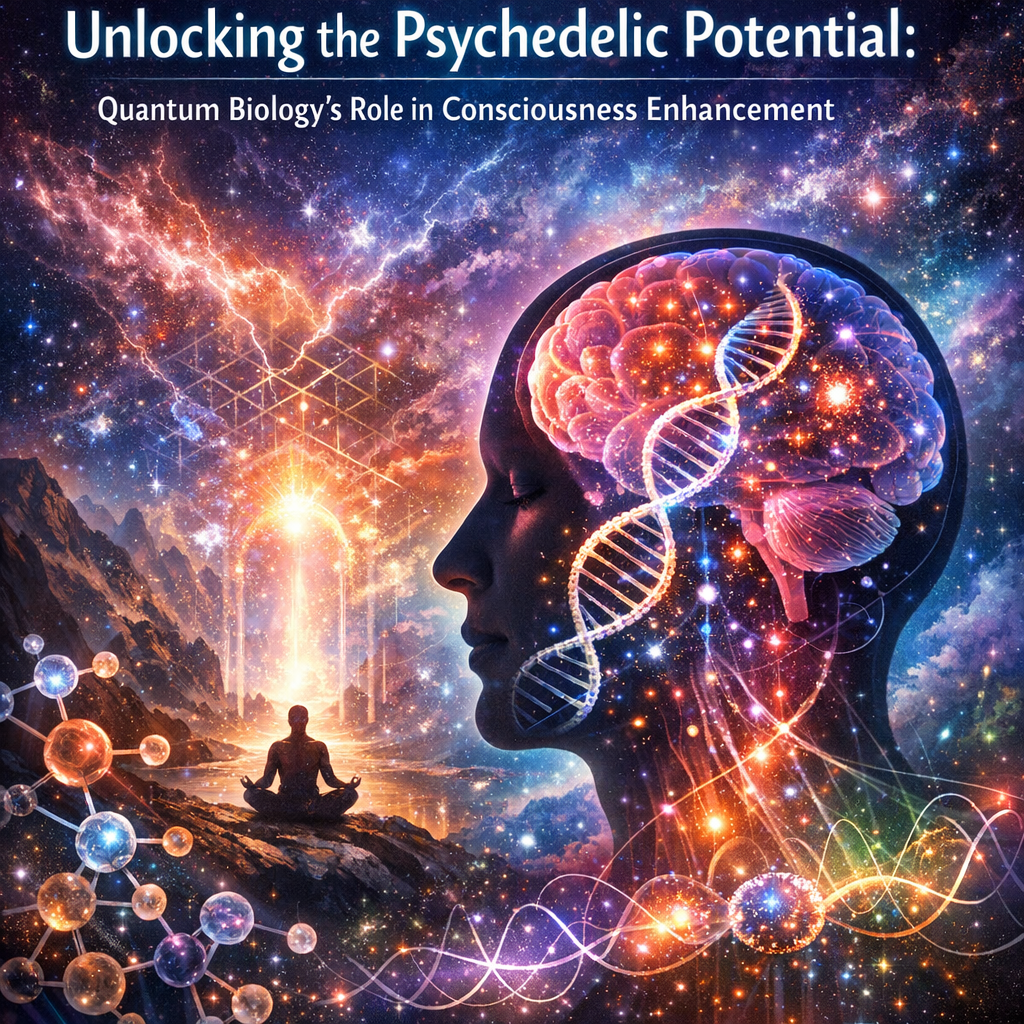
Unlocking the Psychedelic Potential: Quantum Biology’s Role in Consciousness Enhancement
Introduction:
In recent years, the intersection of **psychedelics** and **consciousness** has been a vibrant area of research, drawing attention from scientists, clinicians, and curious minds alike. As societies globally are starting to accept and explore the therapeutic potentials of substances like **psilocybin**—the active ingredient in **magic mushrooms**—there is a parallel interest in understanding how these compounds affect consciousness at a fundamental level. This interest often leads us into the realm of **quantum biology**, an emerging field that proposes that quantum mechanisms can explain biological phenomena, potentially explaining aspects of consciousness traditionally elusive to scientific observation.
**Quantum biology** suggests that quantum mechanical processes are not limited to non-living systems but do indeed play a role in biological processes. Examples include **photosynthesis**, **enzyme activity**, and even **bird navigation**, with the suggestion that these processes leverage quantum phenomena to gain efficiencies or capabilities not otherwise explainable by classical physics.
The implications of quantum biology are immense for consciousness research. **Consciousness**, often considered the final frontier of biology, lacks a sufficiently robust scientific explanation. The idea that psilocybin and similar compounds could act as tools to modulate quantum processes within the brain presents an opportunity to peer deeper into the nature of consciousness and its enhancement. Instead of focusing solely on molecular pathways and neurological networks, this perspective encourages a deeper inquiry into the subatomic interactions within neurons that might influence perception, cognition, and, ultimately, our awareness.
As interest in the therapeutic applications of psilocybin grows, especially for conditions like **depression**, **PTSD**, and **anxiety**, delving into quantum biology might unlock new paradigms in consciousness exploration. Such a synergy of psychedelic research and quantum biological insights might even lead us to transformative experiences of consciousness enhancement, giving individuals access to heightened perception and a deeper understanding of the self and the world.
Features:
Several professional and medical studies have begun to shine a light on the intriguing relationship between **psychedelics**, **quantum biology**, and **consciousness**. While this research is in its infancy, the findings thus far are promising.
One study of note explores the non-classical states induced by psychedelics in the brain. Researchers are investigating the possibility that psilocybin’s effects on the **serotonin receptors**, particularly the **5-HT2A receptor**, might involve quantum-level interactions that excitingly deviate from classical biological expectations. This challenge to conventional neuroscience suggests a complex interplay at work, where psychedelics might induce unique quantum states that facilitate enhanced neural communication [source](https://www.frontiersin.org/articles/10.3389/fnins.2019.00524/full).
In a theoretical exploration of quantum biology, it has been suggested that brain **microtubules**—a component of cellular structures—could serve as quantum processors, modulating the brain’s function via quantum mechanical principles. This theory, often related to the understanding of consciousness, posits that psychedelics may affect consciousness by interacting at this quantum level, thereby altering perception and cognitive function in ways not fully understood by classical models [source](https://royalsocietypublishing.org/doi/10.1098/rsfs.2014.0057).
Furthermore, clinical trials on **psilocybin therapy** for **depression** and **anxiety** have highlighted significant changes in brain connectivity, offering tantalizing glimpses into how altered states of consciousness might correlate with observable structural changes in the brain. These studies frequently report rapid and sustained improvements in mental health outcomes, which some researchers hypothesize may be due to psilocybin catalyzing quantum processes that encourage new neural pathways and cognition routes [source](https://www.thelancet.com/journals/lancet/article/PIIS0140-6736(18)31778-7/fulltext).
As these studies progress, they promise to deepen our understanding of how **quantum biology** could mediate psilocybin’s effects, thus facilitating advances not only in psychedelic therapies but also in our fundamental grasp of consciousness itself.
Conclusion:
As the fields of **quantum biology** and **psychedelic research** continue to converge, they hold the potential to unlock new dimensions of understanding human consciousness. The intricate dance of **psilocybin** with the human brain, particularly at the quantum level, invites scientists and enthusiasts alike to rethink the nature of our awareness and its enhancement. With continued research and exploration, this fusion could lead to profound discoveries that reshape our approach to mental health, consciousness, and the innate capabilities of the human mind.
**Concise Summary:** The emerging field of quantum biology is shedding light on how **psychedelics** like **psilocybin** might enhance consciousness through quantum mechanics. By examining quantum processes in biological systems, such as those in **microtubules** or **serotonin receptors**, researchers are beginning to understand the potential of psychedelics to alter perception and cognition. This burgeoning research promises to transform therapy for conditions like **depression** and **anxiety**, offering insights into consciousness and mental health by integrating psychedelic exploration with quantum biological insights. The synergy between these fields aims to reshape our understanding of the human mind and its capabilities.

Dominic E. is a passionate filmmaker navigating the exciting intersection of art and science. By day, he delves into the complexities of the human body as a full-time medical writer, meticulously translating intricate medical concepts into accessible and engaging narratives. By night, he explores the boundless realm of cinematic storytelling, crafting narratives that evoke emotion and challenge perspectives. Film Student and Full-time Medical Writer for ContentVendor.com