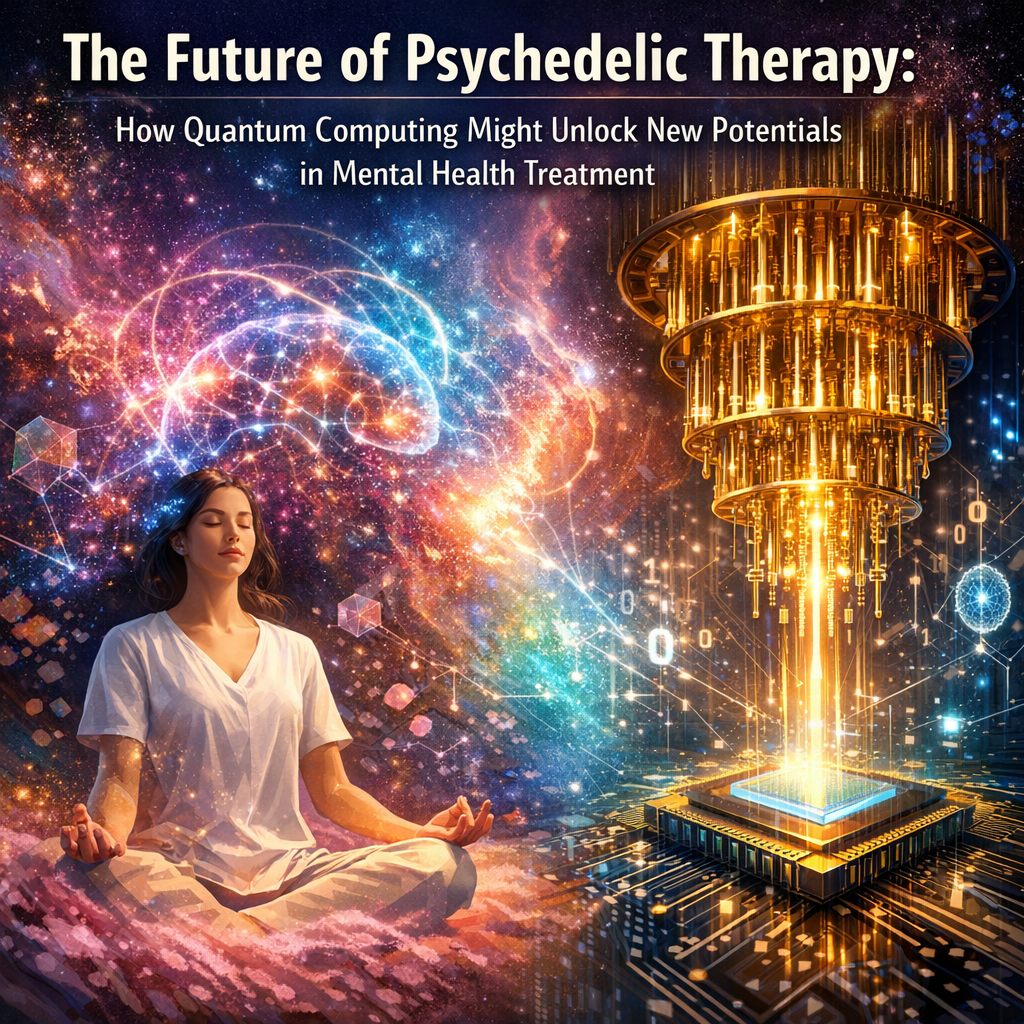
The Future of Psychedelic Therapy: How Quantum Computing Might Unlock New Potentials in Mental Health Treatment
Introduction
In recent years, **mental health treatment** has undergone a paradigm shift, with **psychedelic therapy** emerging as a promising avenue for addressing persistent mental health challenges. **Psilocybin**, the active compound found in “magic mushrooms,” has shown significant potential in treating conditions such as **depression**, **anxiety**, and **PTSD**, offering new hope where traditional therapies have fallen short. But as we stand on the brink of a therapeutic revolution, another technological advancement is poised to transform the landscape of mental health treatment: **quantum computing**.
**Quantum computing** represents a leap in processing power and problem-solving capabilities, far exceeding that of classical computers. By leveraging the principles of **quantum mechanics**, these computers have the potential to perform complex calculations at unprecedented speeds. The fusion of quantum computing and psychedelic research may unveil new pathways for understanding how **psychedelics** affect the brain and uncover new therapeutic potentials.
The convergence of these two fields could propel psychedelic therapy to new heights by accelerating **drug discovery**, personalizing treatment plans, and deeply understanding the brain’s quantum-biological processes. Quantum computing can simulate molecular interactions with high precision, allowing researchers to explore the intricate dynamics of psychedelics interacting with neural receptors. Such insights could lead to the development of novel psychedelics with tailored effects, maximizing benefits while minimizing potential risks.
Moreover, quantum computing could enhance personalized medicine by analyzing vast amounts of genetic, biological, and psychological data. By better understanding individual differences in response to psychedelic therapy, clinicians can design targeted treatment plans, ultimately improving patient outcomes.
As mental health continues to challenge traditional treatment approaches, the synergy between psychedelic therapy and quantum computing signals a transformative era—one where the mysteries of the mind can be unveiled, revealing richer landscapes for healing and understanding.
Features
Scientific research in the fields of **psychedelics** and **quantum computing** provides exciting insights that could redefine mental health treatments. Key studies highlight the therapeutic potential of psilocybin, which are essential to psychedelic therapy’s growing acceptance.
One significant study from **Johns Hopkins Medicine** demonstrates that a single dose of psilocybin can produce rapid and lasting reductions in depression symptoms [source](https://pubmed.ncbi.nlm.nih.gov/33177688/). The randomized, double-blind trial revealed substantial improvements in patients’ mental health, suggesting that psilocybin could complement existing treatments or provide alternatives for those who have not responded to conventional medications.
Parallelly, advances in quantum computing show promise in drug discovery. Quantum computers’ ability to model molecular structures with extraordinary accuracy accelerates the identification of new compounds, potentially leading to less toxic and more effective psychedelics with specific therapeutic targets. **IBM’s research into quantum chemistry** showcases its capability in identifying molecular properties that would be challenging to deduce using classical methods [source](https://www.ibm.com/quantum-computing/).
The interplay between quantum computing and neuroscience is another area of growing interest. **Cambridge Quantum Computing** is developing quantum algorithms aimed at modeling neurobiological processes with greater detail [source](https://cambridgequantum.com/). Understanding these complex interactions could elucidate how psychedelics influence brain states, forging pathways to treatments tailored to cognitive and emotional irregularities seen in mental health disorders.
Collectively, these professional and medical studies highlight a burgeoning intersection where quantum computing not only boosts the efficacy of psychedelic research but also facilitates a more efficient, personalized approach to mental health care. As research progresses, the potential for holistic and customized mental health treatments continues to expand, underscoring the profound impact of integrating cutting-edge technologies with ancient therapeutic modalities.
Conclusion
The future of psychedelic therapy is inevitably intertwined with quantum computing’s rise, promising to redefine mental healthcare as we know it. By merging quantum mechanics’ computational prowess with the healing potential of psychedelics, researchers can unlock novel therapies poised to tackle mental health challenges with enhanced precision and personalization. As this innovative frontier unfolds, it invites us to reimagine the possibilities of human healing and understanding.
### Concise Summary
The integration of **psychedelic therapy** and **quantum computing** presents a groundbreaking opportunity to enhance mental health treatments. **Psilocybin** shows promise in treating mental health conditions, while quantum computing offers unparalleled processing power to understand and enhance these therapies. This synergy could revolutionize drug discovery, personalize treatment plans, and provide deep insights into the brain’s processes, leading to more effective and tailored mental health solutions. Together, these fields herald a transformative era for mental healthcare, blending cutting-edge technology with ancient therapeutic practices.

Dominic E. is a passionate filmmaker navigating the exciting intersection of art and science. By day, he delves into the complexities of the human body as a full-time medical writer, meticulously translating intricate medical concepts into accessible and engaging narratives. By night, he explores the boundless realm of cinematic storytelling, crafting narratives that evoke emotion and challenge perspectives. Film Student and Full-time Medical Writer for ContentVendor.com