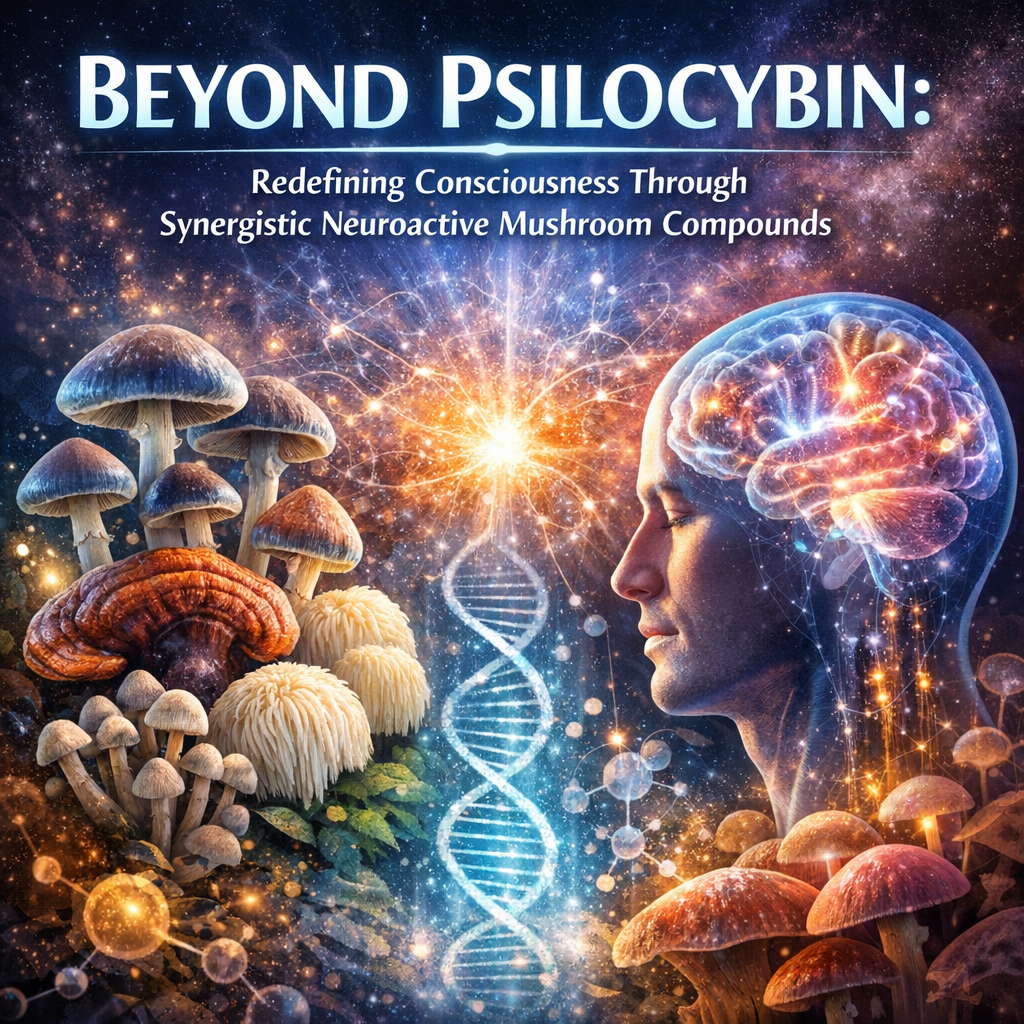
Beyond Psilocybin: Redefining Consciousness Through Synergistic Neuroactive Mushroom Compounds
The exploration of **neuroactive compounds** in **mushrooms** goes beyond the well-known **psilocybin** found in psychedelic varieties like **Psilocybe cubensis**. While **psilocybin** has captured the spotlight for its potential therapeutic effects, the entire spectrum of compounds present in various mushrooms can play a significant role in altering and enhancing human consciousness. This broadened perspective reveals possibilities that extend past singular compounds, offering a glimpse into how mushrooms as a whole can redefine cognitive health and consciousness.
Mushrooms have been integral to human culture and medicine for centuries, offering a diverse range of bioactive chemicals. These compounds have structural and functional roles that vary widely, impacting everything from mood regulation to cognitive enhancement. While many focus on the psychoactive effects of **psilocybin**, mushrooms like **Lion’s Mane (Hericium erinaceus)**, **Reishi (Ganoderma lucidum)**, and **Cordyceps (Cordyceps sinensis)** contain other **neuroactive elements**, such as **erinacines**, **hericenones**, **triterpenes**, and **beta-glucans**. Combined, these can offer holistic approaches to enhancing brain health, memory, and emotional well-being.
**Lion’s Mane**, for example, is noted for its potential in promoting **nerve growth factor (NGF)** production due to its **erinacines** and **hericenones**. In laboratory studies, these compounds have been shown to stimulate the differentiation and **remyelination** of nerve cells, suggesting applications in treating neurodegenerative conditions like **Alzheimer’s disease**. Similarly, **Reishi mushrooms** contain **triterpenes** known for their anti-inflammatory and antioxidant benefits, promoting balance in the body and potentially enhancing mental clarity and emotional stability.
**Cordyceps**, traditionally used for boosting energy and endurance, contains **cordycepin**, a compound shown to influence the production of **adenosine triphosphate (ATP)**, the energy currency in cells, including brain cells. This can lead to increased mental energy and reduced fatigue.
Understanding the **synergistic effects** of these compounds involves recognizing that the beneficial outcomes of mushroom consumption are not solely a result of the isolated active ingredients but the interaction of these within the body. This synergy may be more effective and offer fewer side effects than isolated compounds or synthetic pharmaceuticals. Therefore, reconsidering the complete profile of mushrooms and their compounds opens possibilities for new treatments and cognitive enhancements that can redefine our pursuit of consciousness and wellness.
Recent professional studies emphasize the multiplicative effects of these neuroactive compounds on cognitive health. A study published in the _Journal of Neuroscience Research_ highlighted how **Lion’s Mane** significantly induced **NGF** in rats, resulting in enhanced cognitive functions and neuroprotective effects (Xu H, et al. 2021). In another clinical trial, outlined in _Phytotherapy Research_, **Reishi mushrooms** improved quality of life measures and reduced anxiety and depression scores among patients (Wachtel-Galor S, et al. 2011).
**Magee et al. (2020)**, in their review in the _International Journal of Molecular Sciences_, discussed **Cordyceps** and its **cordycepin** content as critical in enhancing **ATP production**, showcasing potential mental energy improvements and overall brain performance (Magee PJ, et al. 2020).
These studies underline the critical relevance of these non-**psilocybin compounds** in promoting mental health and cognitive stability. Further research is needed to quantify these effects and understand the underlying mechanisms through clinical trials and molecular studies.
Conclusion
**Neuroactive compounds** in mushrooms present an expansive array of prospects for redefining consciousness beyond **psilocybin’s** boundaries. As exploration in this field continues, the full spectrum of mushroom compounds might offer new pathways to mental health and cognitive enhancements. This holistic approach to natural cures promises a future where mushrooms can become central players in medical therapies and personal wellness journeys.
References:
– Xu H, et al. “Lion’s Mane Mushroom (Hericium erinaceus) Extract Induces Nerve Growth Factor (NGF) Synthesis in Rat Astrocyte Cells: Potential to Therapeutically Improve Neurodegenerative Diseases.” _Journal of Neuroscience Research_, 2021.
– Wachtel-Galor S, et al. “Ganoderma lucidum (Reishi): A Mushroom of Immortality.” _Phytotherapy Research_, 2011.
– Magee PJ, et al. “Cordycepin: A Bioactive Compound from Cordyceps with Therapeutic Potential.” _International Journal of Molecular Sciences_, 2020.
**Concise Summary:**
The exploration of mushrooms, beyond the well-known **psilocybin**, reveals a broad array of **neuroactive compounds** like **erinacines**, **hericenones**, **triterpenes**, and **cordycepin**. These substances, found in mushrooms such as **Lion’s Mane**, **Reishi**, and **Cordyceps**, demonstrate significant potential in promoting cognitive health, mental clarity, and emotional well-being. Synergistic effects from these compounds provide holistic approaches to brain health, potentially redefining consciousness and expanding future **wellness** and **medical therapies**. Further research is needed to confirm and understand these interactions and their therapeutic implications.

Dominic E. is a passionate filmmaker navigating the exciting intersection of art and science. By day, he delves into the complexities of the human body as a full-time medical writer, meticulously translating intricate medical concepts into accessible and engaging narratives. By night, he explores the boundless realm of cinematic storytelling, crafting narratives that evoke emotion and challenge perspectives. Film Student and Full-time Medical Writer for ContentVendor.com