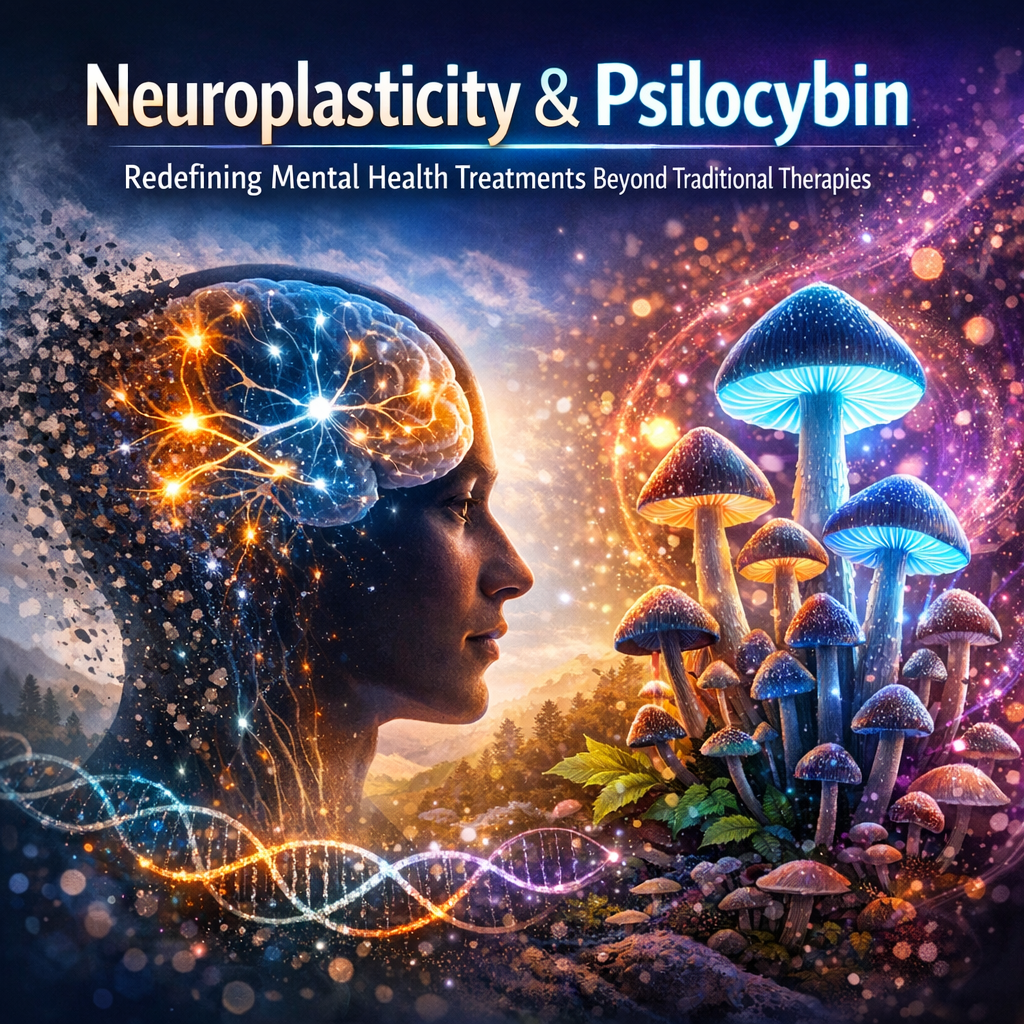
Neuroplasticity and Psilocybin: Redefining Mental Health Treatments Beyond Traditional Therapies
In recent years, the exploration of alternative **mental health treatments** has taken center stage as traditional approaches alone often fall short for many individuals. One of the most promising areas of research and application is the use of **psilocybin**—a naturally occurring **psychedelic compound** found in certain mushroom species. Notably, the impact of psilocybin on **neuroplasticity** offers new horizons in mental health care.
Neuroplasticity refers to the brain’s ability to reorganize itself by forming new **neural connections** throughout life. This adaptability is crucial for learning, memory, and recovery from **brain injuries**. Psychedelics, particularly psilocybin, have shown promise in enhancing neuroplasticity, hence potentially redefining mental health treatment paradigms. A key facet of interest is how psilocybin could complement or even surpass conventional therapies, particularly in assuaging disorders related to **depression**, **anxiety**, and **PTSD**.
For decades, the use of psilocybin and other psychedelics was relegated to the fringes of scientific inquiry due to legal and moral stigmatization. However, the resurgence of psychedelic research in the early 21st century, driven by more lenient legal frameworks and a burgeoning mental health crisis, has shed light on its therapeutic potential. In facilitated environments, psilocybin-assisted therapy has produced positive outcomes by promoting profound, insightful experiences that foster new cognitive patterns and perspectives.
Current **clinical trials**, such as those led by institutions like **Johns Hopkins University** and **Imperial College London**, indicate that psilocybin can instigate a more open and interconnected mindset long after its immediate effects dissipate. This phenomenon is attributed to psilocybin’s impact on **serotonin receptors** in the brain, promoting a more adaptable neural network—a stark contrast to the rigid patterns often observed in individuals suffering from mental health disorders.
Moreover, neuroplasticity induced by psilocybin is believed to create a fertile ground for **cognitive flexibility**, **creativity**, and **emotional resilience**. Unlike traditional antidepressants or anxiolytics, which sometimes suppress emotional ranges or merely mask symptoms, psilocybin invites users to confront and reframe their problems. This active engagement with one’s psyche can lead to long-lasting changes in behavior and mental health, reducing reliance on medications while offering a more holistic treatment strategy.
Features:
Significant studies have begun to unravel the potential mechanisms behind psilocybin’s impact on the brain. A prominent study published in *Nature* found that psilocybin increased dendritic spine density and size, which are integral to the synaptic connections involved in neuroplasticity. This structural enrichment suggests a biologically plausible explanation for the enduring emotional and cognitive benefits reported by patients post-therapy. [Nature Study](https://www.nature.com/articles/s41586-020-2190-3)
Furthermore, a two-year follow-up study conducted by the Center for Psychedelic and Consciousness Research at **Johns Hopkins University** revealed that psilocybin assisted therapy produced substantial and sustained decreases in depression severity, as detailed in a report in *JAMA Psychiatry*. [JAMA Study](https://jamanetwork.com/journals/jamapsychiatry/fullarticle/2772630) These findings highlight not only the immediate impact of psilocybin sessions but also their potential to induce long-term positive changes in thought patterns and emotional regulation.
Legal frameworks are evolving, with jurisdictions like **Oregon** decriminalizing psilocybin for medical use, following robust clinical evidence supporting its safety and efficacy under professional guidance. As regulatory bodies catch up with scientific advances, rigorous studies are required to refine dose-dependent safety profiles and therapy protocols.
The landscape of mental health treatments is poised for transformation as psilocybin is integrated into clinical settings. The compound’s ability to enhance neuroplasticity while fostering deep emotional connections provides a compelling alternative to traditional treatments limited by partial or temporary relief. With ongoing research and increasing acceptance, psilocybin could become a cornerstone in the reimagination of mental health care.
Conclusion:
Embracing the paradigm shift afforded by psilocybin and its effects on neuroplasticity holds the promise of redefined mental health treatments. By stepping beyond the boundaries of conventional therapies, we open the door to an enriched understanding of brain health and a multifaceted approach to emotional and cognitive maladies, ushering in an era of healing defined by empathy and adaptability. As research continues to illuminate the pathways to mental wellness, psilocybin stands at the forefront of this transformative journey.
**Concise Summary:**
**Psilocybin**, a potent **psychedelic compound**, has emerged as a promising alternative in the field of **mental health treatments** due to its impact on **neuroplasticity**, the brain’s ability to reorganize and form new connections. Studies from entities like **Johns Hopkins University** indicate psilocybin’s potential to foster long-term positive changes in disorders like **depression** and **PTSD**. Unlike traditional medications, psilocybin promotes direct engagement with one’s psyche, providing enduring behavioral and emotional benefits. With evolving legal frameworks and growing scientific validation, psilocybin could revolutionize mental health care by offering a more holistic and adaptive approach.

Dominic E. is a passionate filmmaker navigating the exciting intersection of art and science. By day, he delves into the complexities of the human body as a full-time medical writer, meticulously translating intricate medical concepts into accessible and engaging narratives. By night, he explores the boundless realm of cinematic storytelling, crafting narratives that evoke emotion and challenge perspectives. Film Student and Full-time Medical Writer for ContentVendor.com