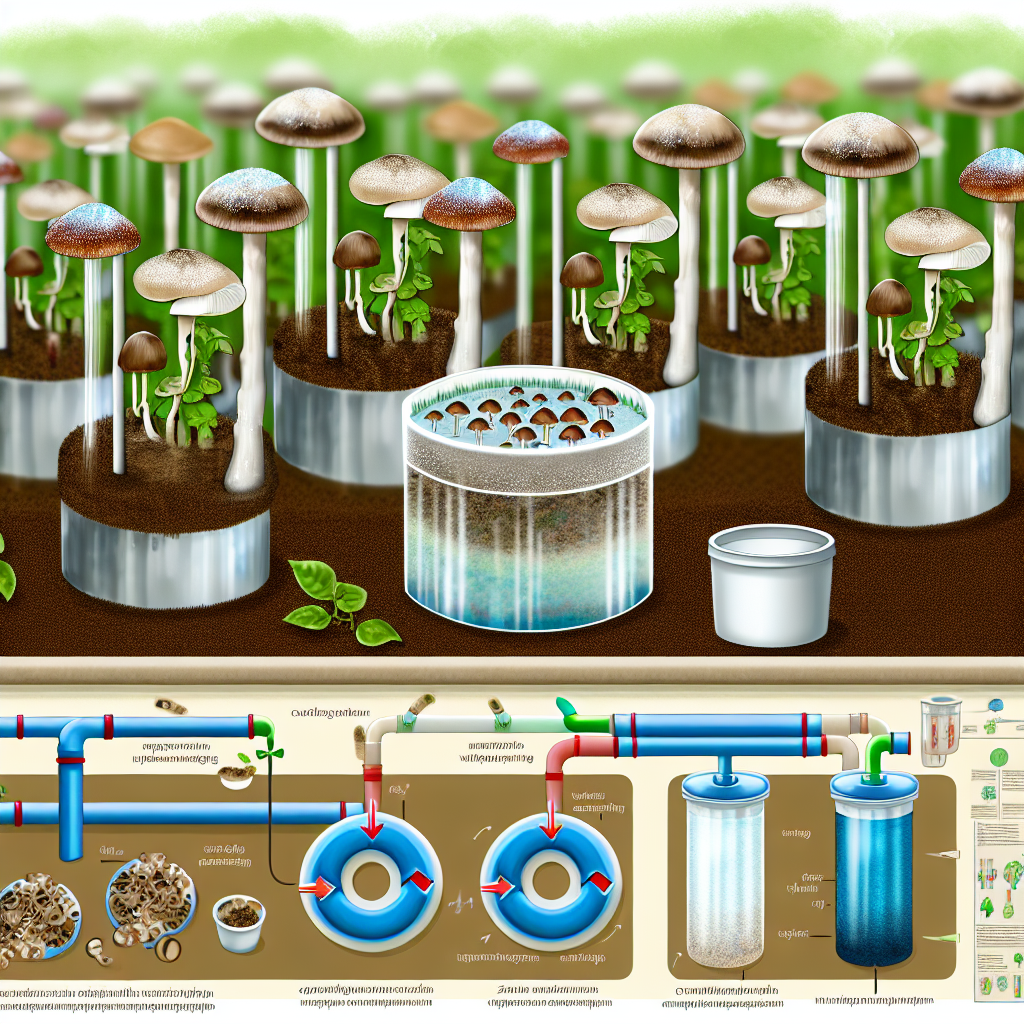
Closed-Loop Hydroponic Systems for Zero-Waste Mushroom Cultivation
Introduction
In recent years, sustainable agriculture has experienced a paradigm shift with the emergence of innovative techniques designed to increase efficiency while reducing environmental impact. One of the most promising developments is the use of closed-loop hydroponic systems for mushroom cultivation. These systems have gained significant traction in both consumer and industrial sectors, particularly for cultivating functional and medicinal mushrooms like **Lion’s Mane** (*Hericium erinaceus*) and **Reishi** (*Ganoderma lucidum*).
Traditional mushroom farming methods, which commonly use substrates like hardwood sawdust, grain, or straw, can generate considerable biological waste and require excessive water resources. In contrast, closed-loop systems recirculate water and nutrients, repurposing outputs such as spent substrate and CO₂ emissions. This self-sustaining method transforms agricultural waste into reusable inputs, leading to true zero-waste farming.
In addition to conserving water and nutrients, these systems deliver improved contamination resistance, allow for environmental control (humidity, temperature, substrate conditions), and result in higher, more reliable yields. They are particularly effective in urban and vertical farming contexts, where space and resources are limited. As such, this approach resonates strongly with the growing demand for eco-conscious production of mushrooms used in natural medicine and nootropic supplementation.
With health and wellness industries embracing fungi with cognitive and therapeutic benefits—including **Chaga**, **Shiitake**, and **Psilocybe** species—there’s a growing emphasis on cultivating them under clean, scientifically optimized systems. Closed-loop hydroponics offers the consistency and purity needed for research into treatments involving **psilocybin**, which is being tested in clinical trials as a therapy for conditions such as depression, PTSD, and addiction.
Moreover, by enhancing nutrient bioavailability and recycling inputs, these systems not only improve public health outcomes but also benefit the environment. With the fusion of precision agriculture, medicinal research, and sustainability, closed-loop mushroom cultivation is poised to become a model for the future of holistic food and healthcare systems.
Features and Supporting Professional Research
Scientific research continues to validate and enhance hydroponic mushroom growing techniques. While fungi differ from traditional hydroponic crops due to their lack of chlorophyll and reliance on mycelial networks rather than photosynthesis, customizing systems to optimize variables like humidity, oxygen flow, and nutrient dispersion has shown substantial success.
A landmark study by [Naraian et al. (2020)](http://www.ijat-aatsea.com/pdf/v16_n3_2020_June/16_IJAT_2020_3_17.pdf) in the *International Journal of Agricultural Technology* explored growing **Pleurotus ostreatus** (Oyster Mushrooms) in hydroponic systems. The findings showed significantly improved mycelial development, higher fruiting body weights, and the successful reuse of substrate water—paving the way for environmentally favorable cultivation.
Moreover, a 2022 paper in [Frontiers in Microbiology](https://www.frontiersin.org/articles/10.3389/fmicb.2022.874568/full) by Chang et al. supports these outcomes. Their research confirmed that closed-loop mushroom systems can **bioconvert cellulosic waste** into valuable bioactive compounds, supporting both sustainable farming and the pharmaceutical use of mushrooms. This also presents an opportunity to upcycle agricultural and food waste into functional, profitable myco-materials.
In the therapeutic mushroom space, standardization and purity are crucial—particularly for **psilocybin** research. A 2021 review in [Nature Reviews Neuroscience](https://www.nature.com/articles/s41583-021-00433-1) highlighted challenges in maintaining consistent psilocybin levels for clinical use. Closed-loop hydroponic systems allow researchers to fine-tune the growing environment, ensuring uniform potency, enhanced absorption of minerals, and reduced exposure to pathogens or heavy metals. This has profound implications for psychedelic-assisted mental health therapies.
Modern technology has also played a role in advancement. Companies like [Eden Grow Systems](https://edengrowsystems.com) and [Smallhold](https://www.smallhold.com) are actively deploying **modular, AI-managed vertical grow systems**, allowing for real-time control of factors such as CO₂, lighting, and humidity. These innovations enhance yield predictability, promote scalability, and further reduce agricultural resource consumption.
In addition, research at [Wageningen University](https://www.wur.nl/en/research-results/research-institutes/plant-research/show-wpr/Circular-agriculture.htm) confirms the compatibility of hydroponics with **circular agriculture principles**. Specifically, they demonstrate how food waste streams in urban environments can be transformed into high-value substrates for **culinary and therapeutic mushrooms**, further closing the ecological loop.
From a medical perspective, enhanced cultivation environments elevate mushroom quality. Clinical research conducted by [Mori et al. (2011)](https://www.jstage.jst.go.jp/article/biomedres/32/1/32_1_67/_article) on **Lion’s Mane** confirmed its potential in diminishing symptoms of cognitive decline. Growing such mushrooms in sterile, data-regulated hydroponic settings ensures cleaner products free from mold and toxins—an essential factor when producing medicinal supplements for neurohealth or immune modulation.
Conclusion
Closed-loop hydroponic mushroom cultivation represents an ecologically sound, scientifically supported innovation with vast potential. By transforming agricultural waste into rich inputs and minimizing environmental pollutants, these systems become a cornerstone in achieving zero-waste agriculture.
The integration of AI, nutrient recycling, and environmental control not only enhances yield and potency of medicinal fungi but also supports sustainable wellness industries. As the therapeutic use of mushrooms grows—especially in psilocybin-based treatments—ensuring sterile, repeatable, and scalable farming conditions becomes a health imperative.
Combining green innovation, therapeutic efficacy, and urban food resilience, closed-loop mushroom farming is poised to be a pillar of the future—where health, science, and planet-friendly agriculture coexist.
Concise Summary
Closed-loop hydroponic systems offer a sustainable, high-yield approach to growing medicinal mushrooms like Lion’s Mane and Psilocybe species. These systems conserve water, eliminate waste, and allow precise environmental control, leading to safer, more potent mushrooms ideal for therapeutic use. Supported by advanced monitoring technologies and scientific research, such systems also upcycle waste and align with urban farming and circular agriculture trends—promising a future of eco-friendly, health-conscious mushroom cultivation.
References
– [Mori, K., et al. (2011). Improving effects of the mushroom Yamabushitake (Hericium erinaceus) on mild cognitive impairment. Biomedical Research.](https://www.jstage.jst.go.jp/article/biomedres/32/1/32_1_67/_article)
– [Chang, S. T., et al. (2022). Bioconversion of Agro-industrial Wastes into Value-Added Mushrooms. Frontiers in Microbiology.](https://www.frontiersin.org/articles/10.3389/fmicb.2022.874568/full)
– [Naraian, R., et al. (2020). Comparative study on hydroponics and conventional techniques for edible mushroom cultivation. International Journal of Agricultural Technology.](http://www.ijat-aatsea.com/pdf/v16_n3_2020_June/16_IJAT_2020_3_17.pdf)
– [Carhart-Harris, R. L., et al. (2021). The psychedelic renaissance and emerging therapeutic uses. Nature Reviews Neuroscience.](https://www.nature.com/articles/s41583-021-00433-1)
– [Eden Grow Systems. (2023). Hydroponic Vertical Modular Growers.](https://edengrowsystems.com)
– [Smallhold – Sustainable Mushroom Farming. (2023).](https://www.smallhold.com)
– [Wageningen University & Research. Circular agriculture research.](https://www.wur.nl/en/research-results/research-institutes/plant-research/show-wpr/Circular-agriculture.htm)

Dominic E. is a passionate filmmaker navigating the exciting intersection of art and science. By day, he delves into the complexities of the human body as a full-time medical writer, meticulously translating intricate medical concepts into accessible and engaging narratives. By night, he explores the boundless realm of cinematic storytelling, crafting narratives that evoke emotion and challenge perspectives. Film Student and Full-time Medical Writer for ContentVendor.com