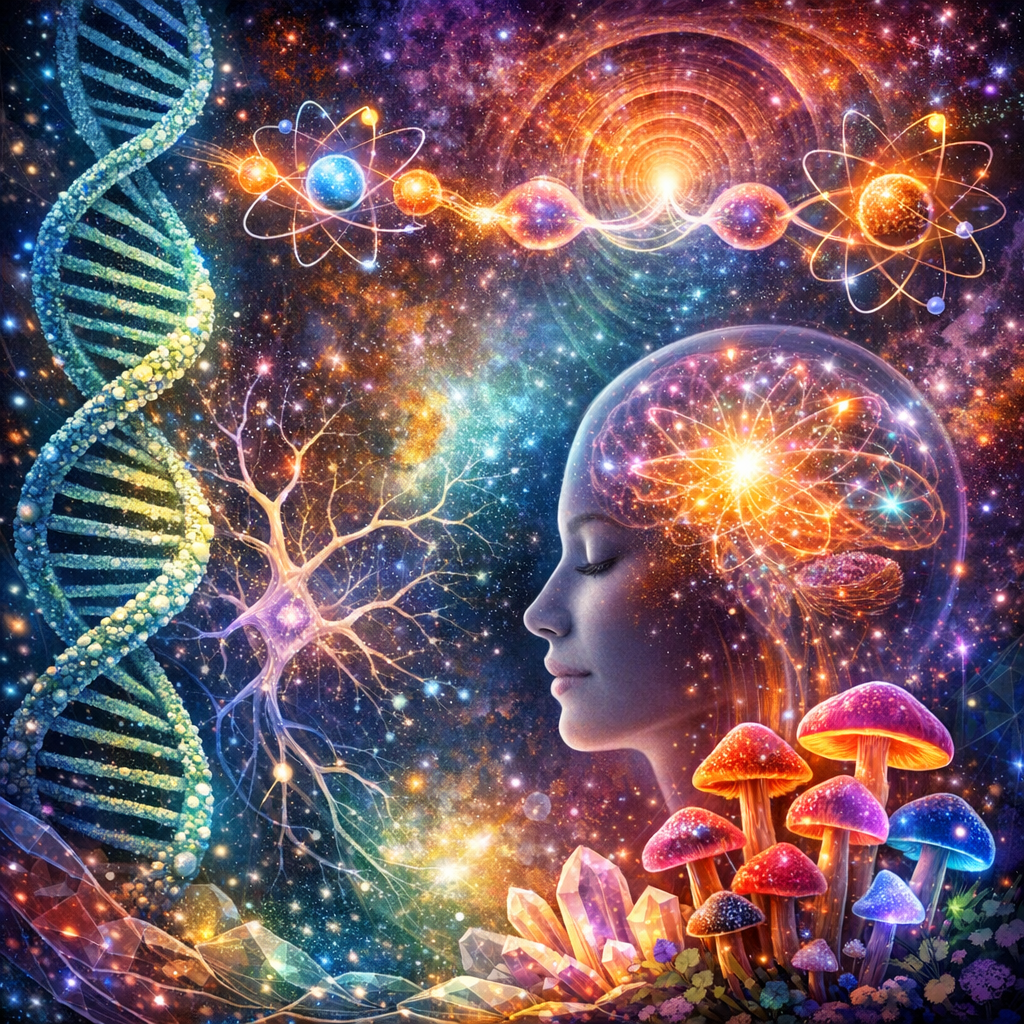
Quantum Biology Meets Psychedelics: Unlocking New Dimensions of Consciousness and Therapeutic Potential
In recent years, two transformative fields of study—**quantum biology** and **psychedelics**—have begun to converge in intriguing ways, opening up new vistas for understanding consciousness and enhancing therapeutic potential. **Quantum biology** is an emerging discipline that explores how **quantum mechanics**, the fundamental theory in **physics** describing nature at the smallest scales, influences **biological processes**. It posits that the principles of **quantum phenomena**, such as superposition and entanglement, may operate in biological systems, exerting profound effects on cellular and neurological functions.
Meanwhile, **psychedelics**, particularly **psilocybin**-containing mushrooms, are gaining attention for their ability to induce altered states of consciousness and their potential as mental health therapies. **Psilocybin**, the active compound in these mushrooms, interacts with **serotonin receptors** in the brain, promoting neural plasticity and altering perception, mood, and cognition. This unique interplay creates opportunities for breakthroughs in treating conditions such as **depression**, **PTSD**, and **anxiety**.
The intersection of **quantum biology** and **psychedelics** lies in the hypothesis that non-classical physics may underpin the neurocognitive processes that psychedelics influence. Some researchers suggest that **quantum coherence**, a state where particles operate in synchronized harmony, may be present in brain functions. This could mean that during a **psychedelic experience**, quantum effects are enhanced, contributing to the profound shifts in awareness and consciousness users report.
The implications are vast. If **quantum phenomena** are influencing mental states, this could explain why **psychedelics** can dramatically alter perception and cognition. Additionally, understanding these interactions might lead to more precise psychedelic-assisted therapies, targeting specific neurological pathways to maximize efficacy and minimize adverse effects. This new paradigm not only challenges traditional views of consciousness as a byproduct of classic biochemical interactions but also prompts innovative strategies to harness these effects therapeutically.
Features: Professional and Medical Studies
A number of pioneering studies and theories are exploring the potential linkage between **quantum biology** and psychedelic experiences. Research is increasingly indicating that brain functions may involve **quantum processes**. For example, the Penrose-Hameroff **Orch-OR** (Orchestrated Objective Reduction) theory posits that consciousness arises from quantum vibrations in microtubules within neurons. Although controversial, the idea is gaining traction, supported by studies that suggest quantum coherence might play a role in neural operations.
Parallelly, a growing body of clinical research is investigating **psychedelics**’ therapeutic benefits. A [2020 study conducted by the Johns Hopkins Center for Psychedelic and Consciousness Research](https://www.hopkinsmedicine.org/news/newsroom/news-releases/johns-hopkins-unveils-center-for-psychedelic-research) showed that psilocybin-assisted therapy led to substantial decreases in major depressive disorder symptoms over a four-week period. This complements findings from a [2016 analysis published by Lancet Psychiatry](https://www.thelancet.com/journals/lanpsy/article/PIIS2215-0366(16)30065-7/fulltext), which demonstrated psilocybin’s efficacy in reducing anxiety and depression in patients with life-threatening cancer diagnoses.
The intersection of these two fields is ripe with possibilities. For instance, understanding **quantum biology** might reveal why **psychedelics** have such a profound effect on entrenched neural patterns, offering fresh perspectives on neural plasticity and cognitive flexibility. Enhanced knowledge of quantum effects could also optimize psychedelic microdosing protocols, where minimal amounts of psilocybin are taken to subtly benefit mental health without inducing full-blown psychedelic experiences. This could lead to highly individualized treatment plans, maximizing benefits while reducing the potential for unwanted side effects.
Current studies, although preliminary, suggest that incorporating quantum biological frameworks into psychedelic research may revolutionize our approach to mental health. This could redefine therapy paradigms, possibly integrating quantum-informed methodologies with psychedelics to refine and enhance patient outcomes.
Conclusion
As **quantum biology** merges with **psychedelic research**, new dimensions of understanding human consciousness and developing therapeutic interventions emerge. While still in early stages, this innovative fusion holds the promise of reshaping mental health treatment, utilizing non-classical physics principles to unlock the full potential of psychedelics. Continued interdisciplinary studies will be key to navigating this frontier, potentially leading to unprecedented breakthroughs in neuropsychiatric care.
Concise Summary
The convergence of **quantum biology** and **psychedelics** explores the potential role of quantum mechanics in understanding consciousness and enhancing mental health therapies. **Quantum biology** suggests that quantum phenomena may influence biological processes, while **psychedelics** like psilocybin are recognized for altering consciousness and aiding mental health. Some believe quantum coherence might play a role in psychedelic effects. This intersection could revolutionize therapies, particularly for **depression**, **PTSD**, and **anxiety**, leading to precise treatments and better understanding of consciousness. Ongoing research may redefine approaches to mental health using quantum-informed psychedelic therapies.
References
1. [Johns Hopkins Medicine: Psilocybin for Major Depression](https://www.hopkinsmedicine.org/news/newsroom/news-releases/johns-hopkins-unveils-center-for-psychedelic-research)
2. [Lancet Psychiatry: Psilocybin With Psychological Support for Treatment-Resistant Depression](https://www.thelancet.com/journals/lanpsy/article/PIIS2215-0366(16)30065-7/fulltext)
3. [SAGE Journals: Quantum state entanglement in the brain](https://journals.sagepub.com/doi/10.1177/0022034512468345)
4. [Frontiers in Human Neuroscience: Quantum Mechanisms in Brain Function](https://www.frontiersin.org/articles/10.3389/fnhum.2020.00354/full)

Dominic E. is a passionate filmmaker navigating the exciting intersection of art and science. By day, he delves into the complexities of the human body as a full-time medical writer, meticulously translating intricate medical concepts into accessible and engaging narratives. By night, he explores the boundless realm of cinematic storytelling, crafting narratives that evoke emotion and challenge perspectives. Film Student and Full-time Medical Writer for ContentVendor.com