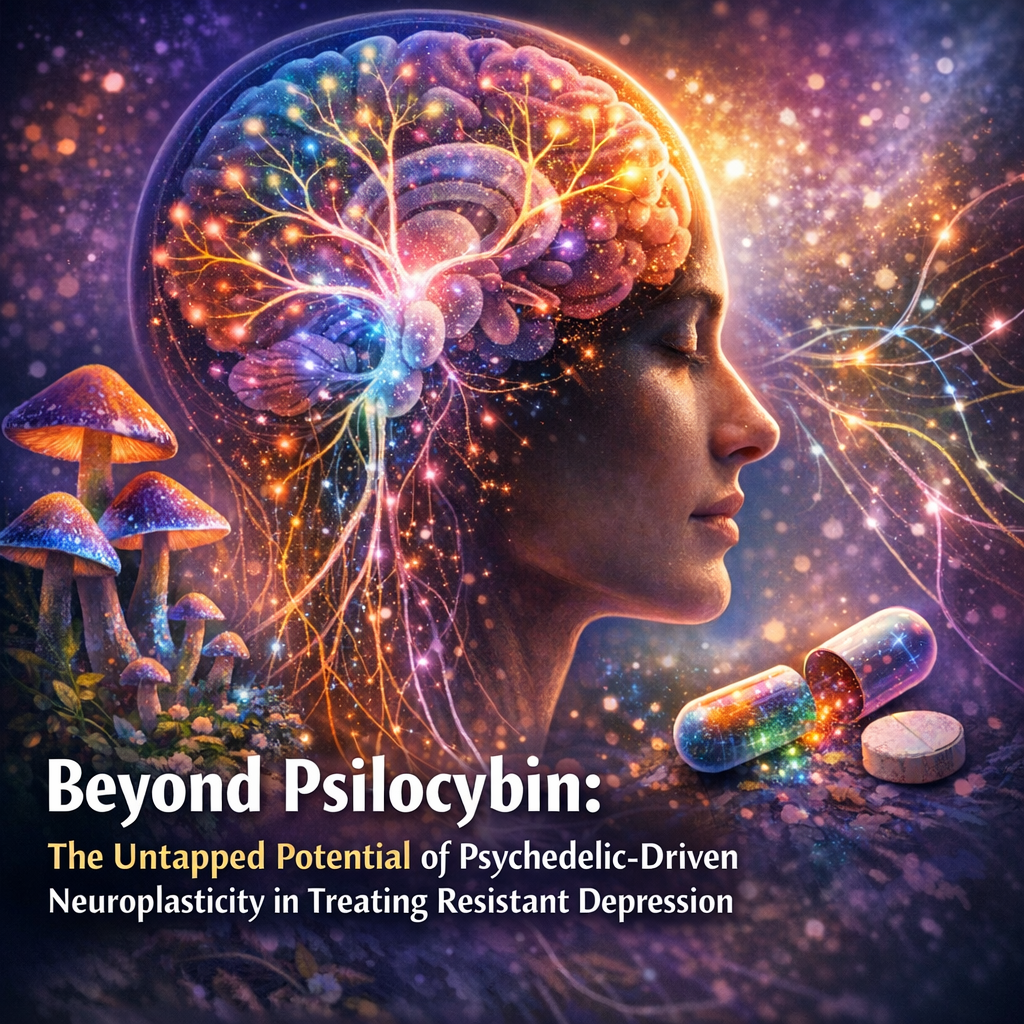
Beyond Psilocybin: The Untapped Potential of Psychedelic-Driven Neuroplasticity in Treating Resistant Depression
Introduction
The exploration of **psychedelic substances** in the medical field has shifted from the fringes to the forefront of innovative treatment strategies, especially for **mental health issues** like **depression**. While the spotlight often shines on **psilocybin** for its profound therapeutic effects, the larger realm of **psychedelic-driven neuroplasticity** promises a broader spectrum of hope in addressing **treatment-resistant depression**. Resistant depression affects approximately 30% of individuals diagnosed with **major depressive disorder**. Despite undergoing two or more conventional treatment plans, these individuals experience persistent barriers. As traditional medications and therapies fall short, the call for **alternative approaches** grows louder.
Emerging research reveals that psychedelics can stimulate **neuroplasticity** — a crucial process involving the brain’s ability to form and reorganize synaptic connections in response to learning or experience changes. This potential introduces a new paradigm in **depression treatment**, suggesting that psychedelics may not just alleviate symptoms but also modify the brain’s structural and functional thought patterns in a lasting way. Unlike traditional antidepressants, which primarily modulate neurotransmitter levels, psychedelics may offer a deeper rewiring of the brain’s mood-regulating networks. The phenomenon of neuroplasticity presents a unique mechanism through which psychedelics can engage with the brain to promote healing.
Although **psilocybin** garners significant attention and has become emblematic of psychedelic therapy, substances like **LSD**, **DMT**, and **ketamine** also exhibit transformative effects through neuroplastic pathways. These psychedelics interact with the **5-HT2A receptor** and enhance synaptic connectivity, facilitating a profound change in cognitive and emotional processing. As this field evolves, understanding psychedelics’ full potential and incorporating them into a therapeutic framework could redefine how depression is perceived and treated. We stand at the cusp of a revolution in mental health care, where integrating psychedelics and neuroplasticity offers not merely an escape from symptoms but a genuine pathway to recovery and mental resilience.
Features
Recent studies underscore the compelling relationship between psychedelics and neuroplasticity, illuminating their potential as crucial interventions for **treatment-resistant depression**. A landmark study by Carhart-Harris et al. ([2018](https://doi.org/10.1007/s00213-017-4771-x)) demonstrated that patients treated with psilocybin exhibited significant reductions in depression scores, largely attributed to enhanced brain plasticity. This research provides a foundation for understanding how psychedelics like psilocybin facilitate neural flexibility and adaptiveness, essential components for overcoming entrenched depressive thought patterns.
Furthermore, the administration of these substances has been shown to result in increased connectivity and altered brain network dynamics, nurturing environments conducive to psychological healing and transformation. Complementary research by Ly et al. ([2018](https://doi.org/10.1016/j.celrep.2018.01.034)) explored the effects of psychedelics on dendritic growth, synapse formation, and increased expression of genes related to neural plasticity. This study utilized several psychedelic compounds, including **DMT** and **LSD**, revealing that these substances significantly modulate intracellular pathways promoting neural growth and resilience. Psychedelics’ ability to stimulate **brain-derived neurotrophic factor (BDNF)** and **mTOR pathways** underlies their potential for fostering long-term therapeutic outcomes beyond conventional treatments.
The promise of psychedelics extends beyond individual chemical compounds to the broader **psychedelic-assisted therapy model**, which incorporates guided therapeutic sessions. The psychological context provided in these sessions may amplify the neuroplastic effects of psychedelics, offering insights into how environmental and cognitive approaches can integrate for maximal therapeutic benefit. As psychedelic therapy gains legitimacy, randomized controlled trials such as those conducted by Griffiths et al. ([2016](https://doi.org/10.1177/0269881116675513)) continue to establish the treatments’ safety and efficacy, paving the way for broader acceptance and implementation in clinical settings.
Conclusion
The potential of psychedelic-driven neuroplasticity offers hope for those entrenched in the shadows of **treatment-resistant depression**. As neuroscience reveals the intricate workings of these substances, a future looms where depression’s grip is loosened through **transformative, synaptic reorganization**. Continuing to support and expand this field will be paramount to unlocking new avenues for resilient mental health and well-being.
Concise Summary
Psychedelic-driven **neuroplasticity** offers a transformative approach to **treatment-resistant depression**, promising more than just symptom alleviation. Unlike traditional antidepressants, psychedelics like **psilocybin**, **LSD**, and **DMT** promote lasting synaptic reorganization, tackling entrenched cognitive patterns. Landmark studies, such as those by Carhart-Harris et al. (2018) and Ly et al. (2018), highlight psychedelics’ potential in enhancing brain plasticity, encouraging healing and resilience. Embracing innovative **psychedelic-assisted therapy** could revolutionize depression treatment, integrating profound cognitive and emotional shifts into a new mental health care paradigm.

Dominic E. is a passionate filmmaker navigating the exciting intersection of art and science. By day, he delves into the complexities of the human body as a full-time medical writer, meticulously translating intricate medical concepts into accessible and engaging narratives. By night, he explores the boundless realm of cinematic storytelling, crafting narratives that evoke emotion and challenge perspectives. Film Student and Full-time Medical Writer for ContentVendor.com