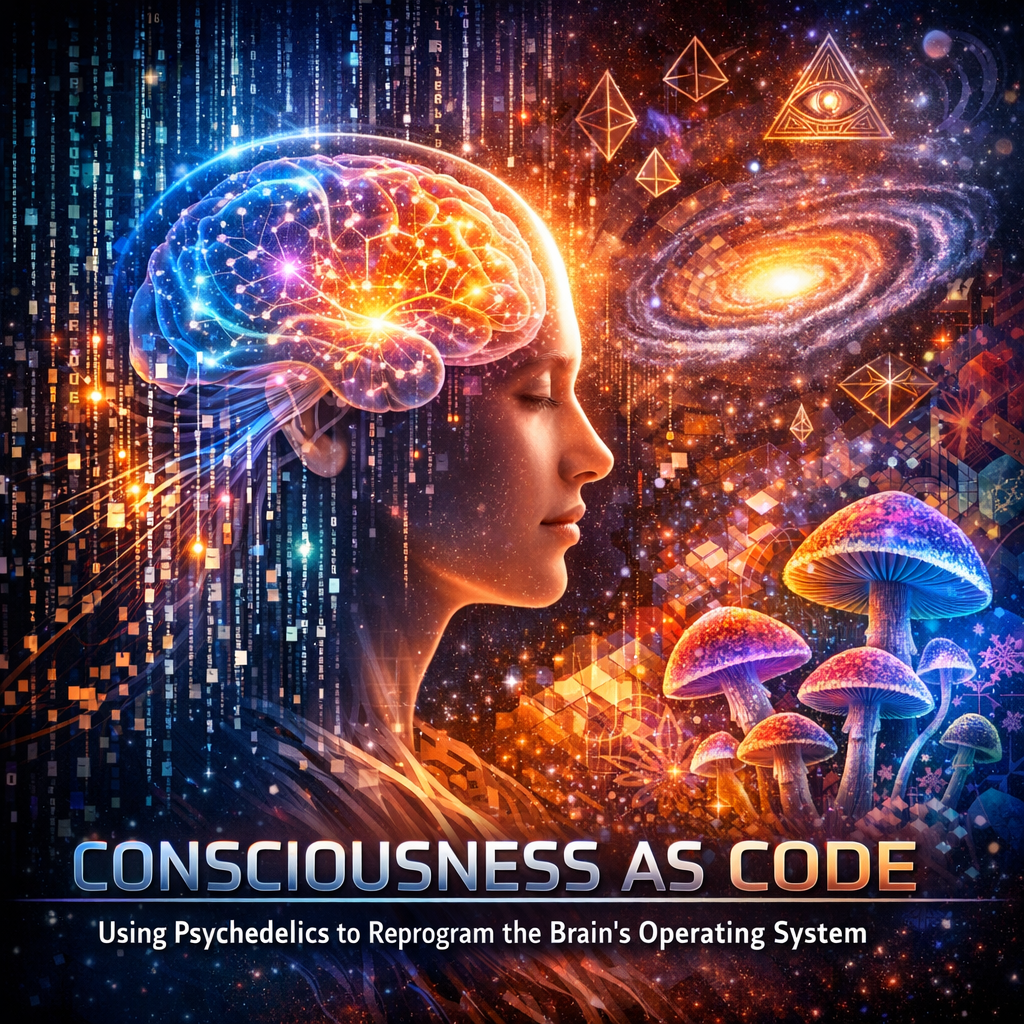
Consciousness as Code: Using Psychedelics to Reprogram the Brain’s Operating System
In recent years, the study of **psychedelics** has **transitioned** from taboo to transformative, offering a potential paradigm shift in how we understand and treat various **mental health conditions**. Among these mind-altering substances, **psilocybin**, the active compound found in certain mushrooms, has taken center stage. Its ability to alter consciousness and stimulate the brain is being likened to reprogramming a computer’s operating system. But how exactly is **consciousness** like code? And in what ways can psychedelics facilitate this intriguing comparison?
Consciousness, especially in the context of **cognitive science**, is often conceptualized as a dynamic yet stable construct. Somehow, our brains seamlessly integrate **memories**, **emotions**, **thoughts**, and perceptions into a cohesive experience of the self. This ‘operating system’ works efficiently for most, yet when disorders like **depression** or **PTSD** interfere, the code underlying our consciousness seems corrupted. Traditional treatments can be slow and sometimes ineffective, leading researchers to explore innovative solutions, including psychedelics.
**Psychedelics** such as **psilocybin** appear to operate like software updates for the mind, fostering **neuroplasticity** – the brain’s ability to reorganize itself by forming new neural connections. This remarkable feature allows individuals the opportunity to overwrite maladaptive patterns. It’s not merely about symptom management; it’s about addressing the root ‘programming’ that leads to these symptoms.
The resurgence of interest in psychedelics has been spurred by a series of promising studies that have begun to decode how these substances might catalyze profound changes in consciousness. By providing a temporary dissolution of the **ego** — our mind’s executive controller — psychedelics open a window of time where deeply ingrained and often destructive patterns of thinking can be evaluated and transformed. This process offers a level of introspection and emotional release that is hard to achieve with traditional therapy alone.
Features: Evidence from Professional and Medical Studies
The renaissance of **psychedelic research**, notably psilocybin, has been gaining momentum. Studies from renowned institutions like [Johns Hopkins University](https://www.hopkinsmedicine.org) and [Imperial College London](https://www.imperial.ac.uk) have been pivotal in elucidating psilocybin’s role in altering consciousness.
A landmark study conducted by **Johns Hopkins** found that a single high dose of psilocybin produced immediate, substantial, and sustained improvements in **anxiety** and **depression** in patients with life-threatening cancer. The study attributed these effects to psilocybin’s capacity to induce profound mystical experiences, leading to shifts in perception and understanding of one’s position in the universe.
Moreover, a study published in the [journal *Nature*](https://www.nature.com) revealed psilocybin’s ability to significantly increase **connectivity** across brain networks, essentially ‘rebooting’ the brain networks associated with depression. This suggests that psychedelics enhance the brain’s adaptive capacity, providing new avenues for breaking out of rigid pathways associated with mental illnesses.
[Imperial College London](https://www.imperial.ac.uk) also conducted a double-blind trial comparing the effectiveness of psilocybin with a leading antidepressant, **escitalopram**. The results demonstrated that psilocybin not only matched but in various aspects exceeded the therapeutic effects of traditional antidepressants over a six-week period.
These studies reinforce the notion that psilocybin’s potential is not just in alleviating symptoms but in providing the tools necessary for self-healing. By temporarily modulating the **default mode network**, which is responsible for the ‘ego’ and self-referential thought, psilocybin allows individuals to break the loop of negative thought patterns that characterizes many mental health disorders.
Conclusion
The analogy of consciousness as code helps us better conceptualize the transformative potential of psychedelics like **psilocybin**. By ‘reprogramming’ the brain’s operating system, we can confront and rewrite the unhealthy patterns that underlie various psychological conditions. As research continues to evolve, the possibility of integrating these substances into mainstream treatment protocols appears not just plausible, but promising. The future of mental health treatment may indeed lie in the depths of the mind, where consciousness and code converge.
**References**
1. [Johns Hopkins Medicine. Psilocybin for Depression and Anxiety.](https://www.hopkinsmedicine.org)
2. [Nature.com – Increased brain connectivity with psilocybin treatment for depression.](https://www.nature.com)
3. [Imperial College London – Psilocybin versus Escitalopram for Depression.](https://www.imperial.ac.uk)
**Concise Summary**
The study of psychedelics, particularly psilocybin, offers a revolutionary approach to treating mental health conditions by likening consciousness to an operating system in need of reprogramming. Recent research highlights how psilocybin can induce neuroplasticity, dissolve the ego, and increase brain connectivity, thus offering profound introspection and a break from negative thought patterns common in depression and anxiety. Studies demonstrate psilocybin’s promise over traditional antidepressants, pointing to its continued integration into mental health treatment. As research progresses, psychedelics may redefine the landscape of therapy by delving into consciousness’s depths.

Dominic E. is a passionate filmmaker navigating the exciting intersection of art and science. By day, he delves into the complexities of the human body as a full-time medical writer, meticulously translating intricate medical concepts into accessible and engaging narratives. By night, he explores the boundless realm of cinematic storytelling, crafting narratives that evoke emotion and challenge perspectives. Film Student and Full-time Medical Writer for ContentVendor.com